Timeline of the history of Columbia and Boone County. Something missing? Let me know at dobrien387 at gmail.com. Want to help keep it up to date or add information, contact the owner of this website, Dianna Borsi O’Brien at dobrien387 at gmail.com
A list of the news coverage about the history of Columbia Missouri is here.
A list of news coverage about Black history coverage is here.
-
-
1812 The Territory of Missouri is organized.
-
1816 – Howard County, now known as the “Mother of Counties,” since from it came many other counties including Boone.
- 1818 — Smithton is founded when 34 speculators buy 2,720 acres of land in what they hope will become a new county to be created out of Howard County. The town is named for the Franklin Land Office’s registrar, Gen. Thomas A. Smith. See this pamphlet outlining the founding of Columbia for more information. 2018_11_11 Smithton brochure
- 1821 — the State of Missouri is admitted to the United States of America after being part of the former “Territory of Missouri.”
- 1821 — The town is moved to an area near the Flat Branch and renamed Columbia. See this pamphlet outlining the founding of Columbia for more information. 2018_11_11 Smithton brochure.
- 1823 — First Baptist Church is the first church of any denomination to meet in Columbia, according to this Nov. 14, 2023 COMO Magazine article. It started meeting in homes, and moved to East Broadway and Waugh in 1891. The present church was built at that location in 1957.
- 1867 — Women first admitted to the University of Missouri. Source: MUArchives.
- 1867 — Rail service to Centralia begins to operate and eventually the railway serving it is called the Wabash. The present stone WABASH Station at 126 N. 10th Street opened Saturday, July 16, 1910, according to the building’s NRHP document.
- Jan. 9, 1892 — The University of Missouri’s main academic building, Academic Hall, burns. The columns are kept and are one of Missouri’s most photographed landmarks.
- Jan. 18, 1884 — The Haden Opera House opens, per the Jan. 25, 1884 issue of Weekly Missouri Statesman. It was located at the northeast corner of Broadway and Ninth. In May of 1897, it would be where the first documented “moving pictures,” were shown using a Vitascope.
- Sept.7, 1889, a Black teenager, George Bush, is lynched after being accused of assaulting a white girl.

- 1890 – POPULATION 4,000
- July 13, 1893 — Electric lights brightened downtown Columbia streets for the first time,” according to a National Register of Historic Places Multiple Property Documentation form, signed Jan. 21, 2004. The document states, “Although efforts to establish a municipal water and light plant had begun in 1890, legal challenges held up the process* and it was finally private investors who supplied the much needed services. A dam and plant were constructed on Hinkson Creek east of the downtown area … The same plant provided a consistent water supply, greatly reducing the threat of disastrous fires.
- 1896 — Plessy versus Ferguson U.S. Supreme Court ruling states that separate but equal facilities are constitutional. This ruling creates a legal foundation for racial segregation. This meant that non-white community members could be barred from any public place such as schools, theaters, restaurants. This would not be overturned until May of 1954 in the Brown versus the Board of Education of Topeka.
- May 28, 1897 — The first documented “moving pictures” were shown at the Haden Opera House.
- 1898 — George Bush or Burke is lynched from the window of the county courthouse, per this information on the CoMo200.com website.
- 1900 – POPULATION 5,651, up 41.3 percent from 1890
- Feb. 23, 1901 — The 1,246-seat Haden Opera House burns. No one is injured. The building is valued at $40,000, or $1.2 million in 2020 dollars.
- 1901 — The 8.5-mile track from Columbia to McBain to connect Columbia to the Missouri, Kansas and Texas Railroad was completed, per the NRHP document for the Katy station depot. The station the NRHP document covers was the second depot at its location on Broadway and was built in 1909.
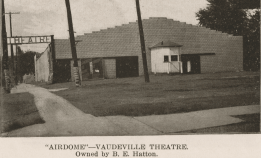
- 1902/1908 — Airdome, a canvas tent with an uncertain opening date, was opened between Sixth and Seventh street on Broadway by B.E. Hatton. It would later move to Walnut and Tenth St., where it burned in 1919.
- 1904/1907 — The Nickelodeon opened in either 1904 or 1907, depending the source. It was initially owned by Mrs. Joseph (Della) Craigo, one of only two of Columbia’s movie theaters to be owned by a woman. The theater at 1008 E. Broadway would be called the Nickel, Broadway Odeon and the Cozy over the years until it closes in the 1920s. The space is used for retail until 1935, it opens as a theater again, this time as the Uptown Theatre.
- 1905 — W.B. West drives to St. Louis to buy an automobile and becomes Columbia’s first resident to own a car.
- 1907 — Columbia Theatre opens on March 12, 1907 as an opera house, per the Centralia Fireside Guard. The 1103 E. Broadway theatre shifts from live performances to showing movies, which become its main stay by 1915. It was built by J.W. Stone and W.W. Garth Jr. Stone’s son, J. Dozier Stone, would go on to build the Missouri Theatre.
-

1907 Columbia Theatre. - 1909 — KATY Station at 402 E. Broadway opens. The 8.5 mile connection links Columbia to the MKT or the KATY, which would eventually extend from St. Louis to Houston via Parsons, Kansas and Dallas. This connection served passengers and freight until 1958, and then only for freight until sometime in the 1960s. The station was sold to private interests in 1976 and renovated at that time. The KATY Station is on the NRHP.
-
- 1910 – POPULATION 9,662, up 71 percent from 1900
- 1910 — The Columbia Theatre shows the controversial film of the boxing match between Jack Johnson, the first African American Heavyweight Champion of the World, and Jeff Jeffries. Showing the film causes riots in 50 cities across the U.S.; in Columbia there were no reports of violence following the film.
- Aug. 28, 1916 — Columbia’s first movie palace, The Hall Theatre, opens, a year after the nation’s first movie palace opens.
- 1917 — Columbia building boom with $400,000 in new construction including the McKinney Building. Citation:Broadway_E_411_Mayors Report 2024_11_18 50dc559a-4585-434d-8d48-899257245d5c.pdf
- April 6, 1917 — U.S. enters World War I.
- Fall of 1918 — Columbia sees its first death attributed to the misnamed Spanish Flu.
- Nov. 11, 1918 — Armistice Day/the end of World War I.
- February 1919 — Spanish Flu considered over in Columbia.
- February 18, 1919 — Airdome Theatre, then the Palace Roller Skating Rink, burns.
- 1920 – POPULATION 10,392, up 8 percent from 1910
- Jan 1, 1920-Dec. 5, 1933 Prohibition. The 18th Amendment banned the manufacture, transportation and sale of intoxicating liquor.
- 1923 — James T. Scott is lynched on April 20, 1923 from Stewart’s bridge at the corner of Stewart and Providence roads. For more information on this lynching, see the entry on the CoMo200.com website. Note, the Missouri State Historical Society has a collection of information on a 2010/2011 James T. Scott Monument Committee, which raised publicity and funds to mark Mr. Scott’s grave. There is an indepth article on the event published Summer 1991. The Lynching of James T. Scott: The Underside of a College Town, Gateway Heritage magazine, vol. 12, no. 1, Summer 1991. Copyright
 by the Missouri Historical Society.
 - March 9, 1927 — W.J. Hetzler elected mayor of Columbia, per this clipping from the March 9 1927 Columbia Daily Tribune, page 1, col. 8.
- Oct. 4, 1927 –Death of J.W. “Blind” Boone on Oct. 4, 1927.
- July 2, 1928 — “Talkie” movies debut in Columbia at the Hall Theatre less than a year their national launch. Columbia was the third city in Missouri to show talkies, after St. Louis and Kansas City.
- March 3, 1929 — The Columbia Theatre partially burns and closes. The building is later remodeled and the upper two stories are removed. As of 2022, it houses lawyers’ office.
- Oct. 6, 1929 — Regular showing of Sunday movies began on this date at the Missouri Theatre. Columbia’s other movie theaters would soon follow.
- Oct. 29, 1929 — Black Friday, the Wall Street crash marks the start of the Great Depression. In Columbia, one of the effects of the Depression was the end of high-profile building projects such as the 1928 Missouri Theatre and Tiger Hotel.
- 1930 – POPULATION 14,967, up 44 percent
- 1930 University of Missouri enrollment, 3,986 per Mizzou Today, published 2007 by the Curators of the University of Missouri.
- Dec. 5, 1933 Prohibition repealed.
- 1939 — July 18, 1939, Douglass Pool dedicated, according to the African-American Heritage Trail app available via OtoCast. It was built in 1938 under a Federal government public works program, according to Columbia’s Parks and Recreation Dept.’s website.
- 1940 – POPULATION 18,399, up 23 percent since 1930
- 1950 – POPULATION 31,974, up 74 percent from 1940
- Dec. 21, 1953 — KOMU broadcasts as the area’s first TV station. According to a Missouri School of Journalism Facebook post, “As the region’s sole station, KOMU carried programming from all four networks: ABC, CBS, DuMont and
NBC.” In 2020, KOMU is an NBC affiliate. The post states, “It is the only commercial TV station in the U.S. that uses its newsroom as a working lab for students. The station’s news department is operated by the J-School.”
- 1954 — On May 17, 1954, The “separate but equal” doctrine is ruled unconstitutional in the Brown vs. Topeka Board of Education case by the U.S. Supreme Court. That doctrine had been in place since with the 1896 U.S. Supreme Court Plessy vs. Ferguson ruling that said separate but equal was constitutional. The 1896 ruling is what made Jim Crow and separate facilities for Black patrons legal until the 1954 and the subsequent 1964 Civil Rights Act.
- BLACK HISTORY — 1958 — Freddie Lee Hayes is the first Black student to earn a four-year degree from the Missouri School of Medicine, according to the book Aesculapius was a Mizzou Tiger by Hugh E. Stephenson, according to this Nov. 3, 2021 article in the Columbia Missourian noting his death at 93 on Oct. 16, 2021.
- 1960 – POPULATION 36,650, up 15 percent from 1950
- 1965 — Columbia’s first mall, Parkade Plaza, opens up in March 1965 on the Business Loop. The Aug. 5, 1966 Columbia Missourian describes it as, “A covered two-level mall that is climate-controlled connects the stores and shops,” and notes it has a parking for 1,571 cars. This change in retail signaled increased suburbanization and led to a downturn in Columbia’s downtown vibrancy for a period of time.
- 1966 — Cinema Theatre opens June 8, 1966 showing The Glass Bottom Boat. Opened by Commonwealth Theaters, it would be bought and sold by United Artists, Crown Cinema and then Hollywood Theaters. Hollywood closed it in 1996. It was Commonwealth’s first residential shopping center theater, heralding a trend of shopping center theaters that would later include the Biscayne III and the Columbia Mall 4. Source: June 6, 1966 Columbia Missourian.
- 1968 — A concrete canopy is installed on Broadway as an effort to bring shopper back downtown after the opening of the first indoor shopping area in 1965, the Parkade Plaza.
- 1968 — ABC Labs founded by Charles W. Gehrke, David Stalling and Jim Ussary. In 2017, it was sold to Eurofins. The story of founder Gehrke is covered in the book “From Melon Fields to Moon Rocks,” by Dianna Borsi O’Brien.
- 1969 — Columbia Mayor Herbert Jeans, Ward 1 – Richard Knipp, Ward 2 – Orville E. Hobart, Ward 3 – Ralph Maledy, Ward 4 – Eugene F. Ruether Jr. https://www.como.gov/council/history/</a
- 1970 – POPULATION 58,512, up 60 percent from 1960
- 1972 — Columbia’s second mall, the Biscayne Mall, opens.
- 1973 — FIRST woman police officer at the Columbia Police Department is Susan Wooderson as of November of 1973, according to the book, “Images of Our Lives Since 1901,” published in 2001 by Columbia Daily Tribune with the cooperation of the State Historical Society of Missouri and the Boone County Historical Society.
- 1980 – POPULATION 62,061, up 6 percent from 1970
- 1985 — Oct. 9, 1985 Columbia Mall opens, according to the CoMo magazine, May 1, 2014. Here’s a look at the Columbia Mall at 2300 Bernadette Drive from the May 14, 2021 Columbia Missourian titled From the archives: Let’s go to the mall. Here’s the link: https://www.columbiamissourian.com/visuals/photos/from-the-archives-lets-go-to-the-mall/article_f9b97080-aaaa-11eb-a88e-03954e004e9c.html
- Nov. 29, 1998 — Cinema Theater closed. Source: Nov. 30, 1998 Columbia Daily Tribune.
- 1990 – POPULATION 69,101, up 11 percent from 1980
- 2000 – POPULATION 84,531, up 22 percent from 1990
- 2000 — University of Missouri, total enrollment 23,280, per Mizzou Today, published 2007 by the Curators of the University of Missouri.
- 2006 — Demolition of the concrete canopy that was installed in 1968. This paves the way for downtown Columbia properties to be named to a National Register of Historic Places, Downtown Columbia Historic District and Downtown Columbia Historic District boundary increase, both designed in 2006.
- 2007 — Columbia named the state’s first Creative Community, by the Missouri Arts Council and the Missouri Department of Economic Development and conferred by the Governor.
- 2010 – POPULATION 108,500, up 28 percent from 2000
- May 4, 2023 — MU demolishes Mizzou North, previously known as Ellis Fischel Cancer Hospital.
 Explore CoMo History